Fable Town: Merging Games
- 4.9
- Rating
- 1.00M
- Installs
- Free
- Price

 Analysis by App-foxy
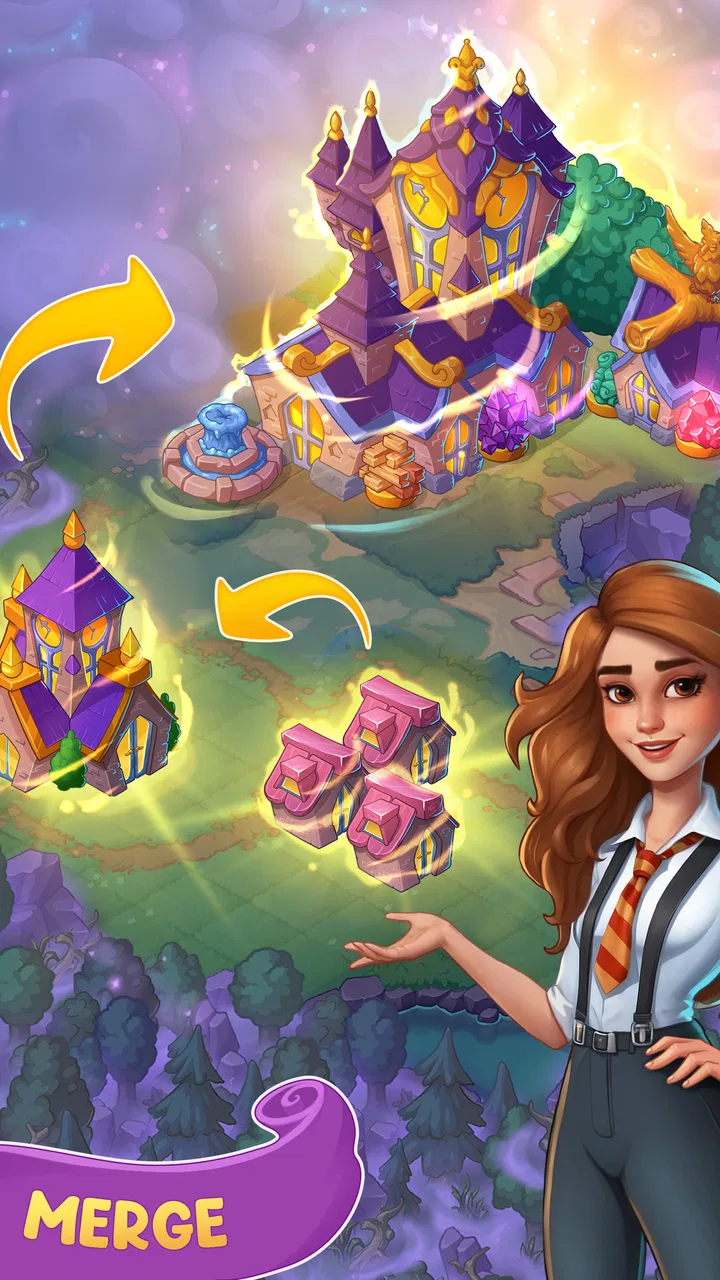
I went into Fable Town: Merging Games expecting a light merge puzzle, and that is exactly where it feels most comfortable. You collect matching objects, combine three of them, and use the resulting items to move through an adventure built around a merging town. It is easy to understand within a few minutes, but the better experience comes from learning how to manage space, timing, and goals instead of merging every possible object immediately.
This is an adventure game from REEF GAMES LTD, available free of charge for Android users who meet its age rating of Everyone. It has attracted a 4.8 average from around 66 thousand ratings and passed over a million installs, which gives a useful idea of its broad appeal. I can see why it works for short sessions: the basic action is simple, progress is visible, and there is usually a small decision waiting on the board.
How the everyday merge loop feels
The baseline workflow is pleasantly straightforward. I look at the available objects, identify groups of three, merge them, and then use the new item to continue the town’s adventure. The important part is not the gesture itself; it is deciding which combination helps the current objective and which one merely clears space. That distinction becomes noticeable once the board starts filling up and every empty position matters.
You May Also Like

 Blood Strike: 2.5 Anniversary
Blood Strike’s Loadouts Turn Every Drop Into a Tactical Gamble
A close look at Blood Strike’s custom loadouts: how fast access to signature weapons reshapes its battle royale rhythm, rewards preparation, and narrows the gap between fights.

 Pandora - Music & Podcasts
Pandora’s Music Is Easy to Start, but Harder to Recover
Pandora’s strength is its low-effort path from a seed to a station. Its weak spot is how much confidence it asks you to place in connection, setup, and quiet recovery.

 8 Ball Pool
 Is Built on Rivalries, Rematches, and Routine
A close look at the rivalries, rematches, shared routines, and unanswered safety questions that turn a quick pool match into a persistent mobile community.

 Samsung Music
’s Quiet Strength Is Playing What You Already Own
Its reach comes less from spectacle than from dependable access to a personal library. That simplicity is both the app’s strongest retention engine and its ceiling.

 AccuWeather: Weather Radar
AccuWeather Review: A Quick, Clear Forecast for Everyday Decisions
For everyday plans, the best forecast is the one you can understand quickly. AccuWeather makes rain timing, radar, and local conditions easy to act on, with a few trade-offs.

 Hill Climb Racing
Why Hill Climb Racing Still Turns Crashes Into One More Run
A tiny car, a bumpy hill and one more upgrade: Hill Climb Racing keeps resurfacing because its simple chaos makes every near-miss feel personal.
More From Our News Desk
View All News


For a quick play session, I usually begin by checking the entire board rather than tapping the first obvious group. A merge near one edge can reveal a better combination elsewhere, while an unnecessary merge may occupy a useful square with an item I cannot use yet. This simple pause is one of the most valuable habits in the game. It makes the experience feel more like planning than repetitive tapping.
The three-item rule keeps the opening accessible. You do not need to learn a complicated crafting tree before making progress, and the visual result of a merge is easy to follow. At the same time, the rule creates a small trade-off: combining immediately gives a quick upgrade, but waiting can preserve flexibility. I found that the game is most satisfying when I treat the board as a limited workspace instead of a pile of objects to process as fast as possible.
A realistic everyday use case is a short break between tasks. I can open the game, make a few deliberate combinations, complete a small piece of town progress, and stop without needing a long uninterrupted session. That makes it a better fit for casual play than for someone looking for a deep, story-heavy adventure that demands full attention for an hour at a time.
The adventure framing also gives the merging a purpose. I am not simply producing higher-level objects in an endless abstract grid; the town provides a sense of direction. Even when the immediate action is repetitive, the surrounding progression helps answer the question of why I should make the next combination. Players who enjoy gentle restoration or collection loops will probably find that structure more inviting than a purely score-based puzzle.
What I check before making the first merge
My preferred opening routine has three steps. First, I scan for all visible groups of three. Second, I note which objects appear close to becoming useful after one combination. Third, I decide whether the current priority is completing an objective or creating room. This takes only a moment, but it prevents the common mistake of spending the best available space on a merge that does not help the immediate task.
I also avoid treating every new item as an instruction to merge again. A newly created object can be more valuable as a future connector than as something to combine immediately. Keeping one useful item in reserve gives me options when the board becomes crowded. This is a non-obvious strength of the three-item system: the game rewards restraint as much as speed.
When I am playing casually, I accept that not every move will be optimal. The game remains approachable because the basic loop does not require a perfect solution to every board. However, players who enjoy optimizing will find enough room to improve their habits. The difference between random merging and planned merging is clear without making the game feel like a spreadsheet.
Settings and session habits that make play smoother
Before settling into longer sessions, I recommend checking the available in-game settings rather than assuming the default setup is ideal. The most useful practical checks are sound, notifications, and any options related to the way the game behaves during play. I do not change settings just for the sake of it; I adjust them around where and when I expect to play.
If I am opening the game during a quiet break, I prefer a less distracting audio setup. If I am playing at home, the original sound can make the board feel more responsive. The right choice depends on the situation, but the broader point is important: a merge game is often played alongside another activity, so controlling interruptions can make the experience more comfortable.
Notifications deserve similar attention. I would keep only the reminders that genuinely help me return to the game and avoid anything that turns a short break into a constant prompt to check the board. This is especially relevant because the title is free to play and includes optional purchases ranging from $0.49 to $119.99 per item. I find it easier to make calm decisions when I open the game on my own schedule rather than reacting to every reminder.
The current version is 1.31.2, and the game runs on Android 7.0 or later. That makes device compatibility fairly broad, although the smoothness of any game can still depend on the phone or tablet being used. I would install it on the device where I normally play short casual games, then check how comfortably the board responds before committing to longer sessions.
One setting-related habit I value is keeping the playing environment consistent. If I usually play with one hand during a commute and with both hands at home, I make sure I am not rushing the same way in both places. The board is easier to manage when I slow down around crowded layouts. This is less about a hidden option and more about using the game’s simple controls carefully.
The age rating of Everyone also makes the presentation approachable for family play, but that does not mean every player will want the same experience. Younger or very casual players may enjoy the immediate combinations, while adults who dislike optional purchase systems should decide in advance whether they are comfortable playing at the free pace. I prefer setting that expectation before starting rather than treating purchases as part of the core loop.
Repeatable patterns for faster progress
The fastest pattern I found is not simply “merge whenever possible.” I group my attention around the current objective, then use spare combinations to create room without destroying useful possibilities. This keeps the board readable. When several groups are available, I start with the merge that either completes a requirement or opens the most space, not necessarily the one that produces the most impressive-looking item.
Another useful pattern is to work from the edges inward when the layout allows it. Clearing an outer position can make the rest of the board easier to inspect, while merging in the middle can sometimes leave awkward gaps around the sides. I do not follow this as an unbreakable rule, because the objective should come first, but it is a good default when several moves appear equally useful.
I also separate “progress moves” from “maintenance moves.” A progress move directly supports the town or the current task. A maintenance move improves the board’s organization or frees a square. Thinking in those two categories helps me avoid spending all my available combinations on tidy-looking changes that do not actually advance anything.
For players who tend to run out of room, the most practical improvement is to stop creating duplicates without a plan. Before making a merge, I ask whether the resulting object has somewhere useful to go. If the answer is no, I look for a different combination first. This habit is particularly helpful during a short session because it reduces the chance of ending with a cluttered board just as the available time runs out.
I would also recommend ending a session at a sensible stopping point. If I have just opened a new area of activity or created several objects that need careful placement, I would rather stop after organizing the board than leave it in a chaotic state. Returning to a readable layout makes the next session feel faster, even though the game itself has not changed.
These habits are more valuable than trying to play at maximum speed. The game’s appeal is in making small decisions repeatedly, and rushing removes the part that gives those decisions meaning. Experienced players will probably enjoy improving their order of operations, while newcomers can simply use the same ideas as gentle guidance.
Where the simple design reaches its limits
Fable Town: Merging Games is not the right choice for everyone. If you want a demanding adventure with direct character control, complex combat, or a large amount of narrative at every step, this will feel too focused on board management. Its adventure identity is expressed through the town and the progression around merging, not through the kind of exploration found in a traditional action-adventure game.
It may also disappoint players who prefer completely open-ended puzzle solving. The three-item system gives you room to make better or worse choices, but the basic action remains consistent. There is comfort in that repetition, yet some players will eventually want more mechanical variety than combining objects and managing space can provide.
The free entry point is convenient, but the optional purchase range is worth considering before installation. I would recommend playing without spending anything initially and deciding whether the natural pace suits you. If progress feels enjoyable at that pace, purchases are easier to view as optional convenience rather than a requirement. If the basic rhythm already feels slow or repetitive, spending more is unlikely to fix the underlying mismatch.
Compared with a conventional match-three game, this title gives more weight to inventory decisions and longer-term organization. A standard match-three alternative is usually better when I want quick reactions, constant board changes, and a clear score chase. This game is better when I want to plan a sequence, preserve useful objects, and watch a setting develop around those choices.
Compared with a traditional town-building game, the merging board makes the interaction more immediate but also narrower. A town builder may offer broader resource planning, construction choices, and management systems. Here, the pleasure comes from the compact loop: combine, create, organize, and use the result to keep the adventure moving. I would choose this one for a lighter, more tactile experience rather than for detailed simulation.
There is also a practical trade-off between accessibility and depth. Because the controls and rule are easy to grasp, I can recommend it to someone who does not normally play adventure games. But the same simplicity means that a player seeking constant novelty may need to supply interest through better planning and personal goals. The game gives you a framework for mastery rather than overwhelming you with systems.
Who I would recommend it to
I would suggest it to players who like calm puzzle sessions, visible progression, and the satisfaction of turning several basic objects into something more useful. It is especially suitable for people who enjoy checking a board, making a few decisions, and returning later. The Everyone rating and straightforward three-item rule also make it approachable for mixed-age households, provided everyone understands how optional purchases fit into their own play style.
I would be more cautious with players who become frustrated by limited space or by repeating a familiar action many times. The game asks for patience. Even when the next merge is obvious, the best move may be to wait, reorganize, or protect an item for later. That can be relaxing for one person and irritating for another.
It is also not my first recommendation for someone who wants a completely offline-feeling distraction with no surrounding progression decisions. A minimalist puzzle game may be a better match in that case. Fable Town works because the board is tied to an expanding adventure context, so players who do not care about that context may find the loop less compelling.
For a friend asking whether to try it, my answer would be yes if they enjoy merge games but want a little more sense of place than a bare puzzle grid. I would tell them to begin with a no-spend trial, check the sound and notification settings, and use deliberate board scans instead of tapping every available group. Those three choices give a much fairer impression of the game than rushing through the opening.
My verdict after learning its rhythm
Fable Town: Merging Games succeeds because it keeps its central idea clear while giving careful players room to improve. The act of combining three items is simple, but the surrounding decisions about board space, objectives, and timing stop it from feeling completely automatic. I especially like that a short session can still feel productive, while a longer session rewards a more organized approach.
My main reservation is that the experience depends heavily on whether you enjoy repetition with gradual progression. The game does not disguise its core loop, and it should not be chosen expecting a conventional adventure with action-heavy exploration. The optional purchase structure is another reason to play at your own pace and decide early whether the free experience feels comfortable.
For me, the best way to play is to treat each board as a small planning problem. I scan first, prioritize the move that supports the current goal, keep useful objects available, and clear space only when it serves a purpose. That approach makes the town feel less like a sequence of random taps and more like a place I am gradually shaping through sensible choices.
REEF GAMES LTD has made an accessible adventure merge game that is easy to start but not entirely mindless to optimize. With a 4.8 average and over a million installs, it has clearly found an audience, and I think its strongest appeal is practical: it fits naturally into short breaks without abandoning the satisfaction of longer-term progress. If you enjoy thoughtful merging more than fast reflexes, this is a free game worth trying.
FAQs for Fable Town: Merging Games
01What is Fable Town: Merging Games about?
Fable Town: Merging Games is a captivating puzzle game that combines elements of matching and strategy. Players are tasked with merging various fabled items to unlock new areas and characters, all while unraveling a magical storyline set in a whimsical world. It's perfect for those who love engaging and relaxing gameplay.
02Is Fable Town: Merging Games free to play?
Yes, Fable Town: Merging Games is free to download and play on both Android and iOS devices. However, it does offer in-app purchases that can enhance the gaming experience, such as additional lives, boosters, and special items. Players can enjoy the game without spending money, but these options are available for those who wish to progress faster.
03What are the system requirements for Fable Town: Merging Games?
For Android users, Fable Town: Merging Games requires at least Android 5.0 and up. iOS users need iOS 10.0 or later. The game runs smoothly on most devices, but for the best experience, it's recommended to have a device with updated software and sufficient storage space to accommodate game updates and data.
04Does Fable Town: Merging Games require an internet connection?
Fable Town: Merging Games can be played offline, making it a perfect option for gaming on the go. However, certain features, such as events, leaderboards, and in-app purchases, will require an internet connection. Playing online also ensures you have access to the latest updates and content from the developers.
05Are there any ads in Fable Town: Merging Games?
Yes, Fable Town: Merging Games includes ads as part of its free-to-play model. These ads can appear between levels or when accessing certain features. Players have the option to remove ads through a one-time purchase, which can enhance the gaming experience by providing uninterrupted play.
Pros
- Engaging storyline keeps players invested.
- Vibrant graphics enhance the experience.
- Frequent updates with new content.
- User-friendly interface and controls.
- Offers offline gameplay for convenience.
Cons
- In-app purchases can be pricey.
- Occasional ads interrupt gameplay.
- Limited lives can slow progress.
- Some players report occasional bugs.
- Requires significant storage space.

Fable Town: Merging Games
Gallery